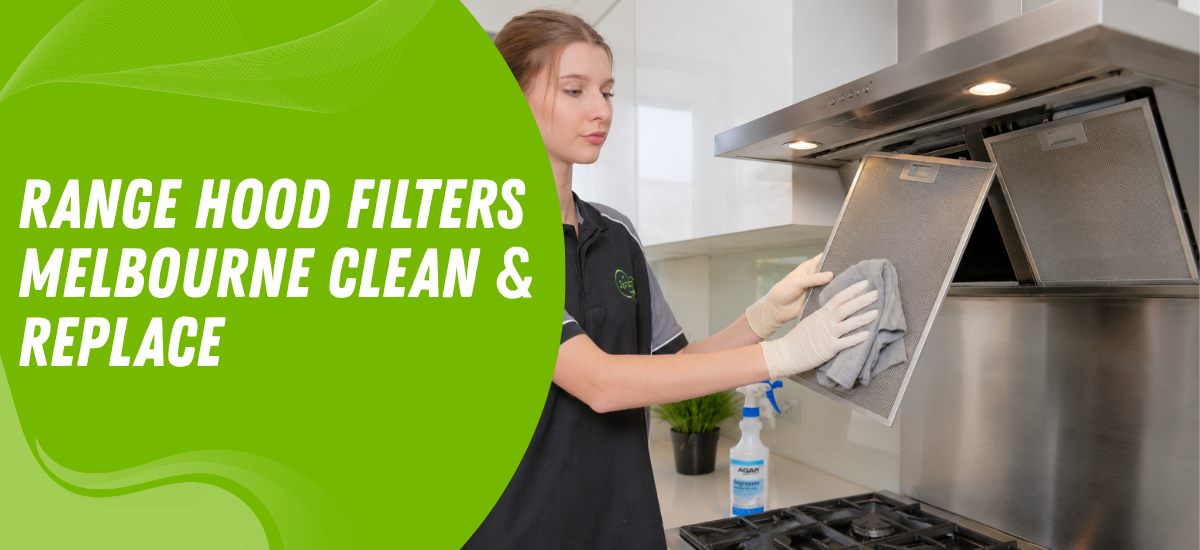
Range hood filters fall into two categories: grease filters that can be washed, and odour filters that can’t. Mesh and baffle filters catch grease and go in the dishwasher. Charcoal and carbon filters absorb odours and get thrown out when they’re spent washing them destroys the media. In a commercial kitchen or office facility, mixing them up means buying the wrong replacement, cleaning something that’s now useless, or skipping maintenance on something that’s quietly becoming a fire hazard.
Table of Contents
ToggleAccording to Spiffy Clean, a provider of commercial cleaning services in Melbourne, “range hood filter maintenance is one of those tasks that gets deferred until there’s a problem, and by that point the grease buildup is a fire hazard and the ventilation performance has already been compromised for months.”
What Is the Difference Between Charcoal and Carbon Range Hood Filters?
The terminology around range hood filters is loose enough that most product listings use charcoal and carbon interchangeably, but the distinction matters when you’re deciding what to buy and what to do with it.
Filter Type | How It Works | Washable? | Notes |
Charcoal filter | Passes air through activated charcoal to absorb cooking odours before recirculating air back into the kitchen | No disposable, fills up over time | Found in recirculating hoods that don’t vent outside |
Carbon filter | Same odour-absorption principle as charcoal filters; functionally identical in most domestic and commercial contexts | No requires replacement | Higher-spec commercial versions have denser media and longer service life |
Grease filter | Traps grease particles before they reach the fan motor; available in aluminium mesh or stainless baffle styles | Yes hand wash with degreaser or commercial dishwasher | Cleaning frequency depends on how heavily the kitchen is used |
Combination system | Uses both a grease filter and a charcoal/carbon filter in the same unit | Grease layer: yes / Odour layer: no | Mixing up which layer does which job leads to costly mistakes washing what needs replacing, or replacing what just needed a clean |
Commercial cleaning services in Melbourne that cover kitchen maintenance build filter inspection into scheduled cleans rather than treating it as a separate job the client has to remember to arrange.
When Should Range Hood Filters in Melbourne Be Replaced or Cleaned?
There’s no universal replacement schedule that works across every kitchen type, but there are reliable indicators that apply regardless of whether the filter is in a home office kitchen, a commercial café or a food production facility.
- Charcoal and carbon filters: Can’t be cleaned and show no visible sign of saturation replace every three to six months in moderate-use kitchens, monthly in heavy commercial services.
- Grease filter cleaning: Commercial kitchens running five days a week need cleaning every two to four weeks beyond that, airflow drops, the motor works harder and grease build-up becomes a fire risk.
- Visual and performance cues: Discolouration, tacky mesh or pooling grease means the filter is overdue regardless of the last service date; a louder, less effective or odour-producing hood almost always points to filters first.
- Post-renovation and heavy-use periods: Construction dust and intensive catering loads accelerate filter saturation in ways a standard schedule won’t catch inspect and replace after any of these events.
And ignoring filter maintenance in a Melbourne food-handling environment isn’t just an operational inconvenience. It’s a compliance and fire safety issue that an inspection will find whether the business is ready for it or not.Read about what is Quality vs Basic Commercial Cleaning to understand how filter maintenance fits into a properly structured cleaning programme.
Why Choose Spiffy Clean?
Jack Sidhu, director at Spiffy Clean, leads an ISO 9001, 14001 and 45001 certified commercial cleaning company serving 500+ businesses across Melbourne with directly employed, police-checked cleaners who handle kitchen facility maintenance, including range hood filter cleaning and inspection, as part of documented, site-specific cleaning programmes rather than as an afterthought the client has to request.
Facilities don’t get a generic clean and a missed filter that causes a problem three months later. They get a consistent team that knows the site, follows a verified maintenance schedule and flags issues before they become compliance failures.
Concerned your Melbourne facility’s range hood filters haven’t been properly maintained?
FAQ
Both absorb cooking odours but carbon filters in commercial systems often have denser media and longer service life.
Charcoal and carbon filters every one to three months in high-use kitchens, grease filters cleaned every two to four weeks.
Grease mesh and baffle filters can be washed. Charcoal and carbon filters can’t and must be replaced when saturated.
Yes, filter inspection and cleaning is included in Spiffy Clean’s documented commercial kitchen facility programmes.