AS/NZS guidelines classify healthcare areas by infection risk and prescribe cleaning frequencies, product types, and documentation requirements for each zone. Melbourne clinics, day surgeries, and allied health practices must align their cleaning programs to these standards as a condition of accreditation. The framework breaks down by zone classification, product efficacy, staff competency, and the audit trail required during inspections.
Table of Contents
ToggleAccording to Spiffy Clean, a provider of commercial cleaning in Melbourne, “AS/NZS standards aren’t a checklist they’re a risk management framework, and facilities that treat them as paperwork rather than practice are the ones that fail accreditation.”
How Do AS/NZS Standards Classify Healthcare Areas and Cleaning Requirements?
The framework isn’t one standard applied uniformly it scales by infection risk, and the protocols shift significantly between zones.
- Risk Zone Classification: Healthcare spaces are divided into low, moderate, and high-risk zones waiting rooms and admin areas sit at the lower end, while treatment rooms, procedure areas, and any space with patient contact or clinical waste fall into higher categories requiring more frequent cleaning with stronger, TGA-listed disinfectants.
- Cleaning Frequency: High-risk zones require cleaning at minimum once per day with additional spot cleans after each patient contact, while low-risk zones can operate on less frequent schedules the standard ties frequency to risk level, not to what’s operationally convenient for the facility.
- Product Requirements: AS/NZS guidelines specify that disinfectants used in healthcare settings must be TGA-listed with documented efficacy against target pathogens general-purpose commercial cleaners don’t meet this threshold regardless of how clean the surface looks afterward.
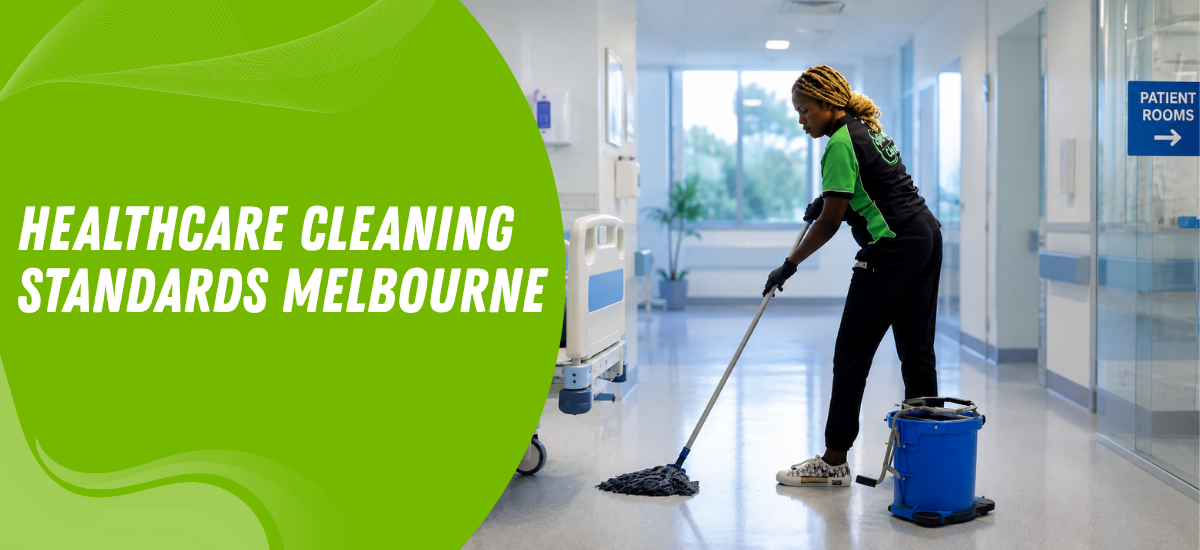
- Colour-Coded Equipment: Mops, cloths, and buckets must follow a colour-coded system to prevent cross-contamination between zones using the same equipment across a waiting room and a treatment area is a direct breach of the standard and a common finding in accreditation audits.
Getting zone classification wrong at the outset means the entire cleaning program is built on the wrong foundation and that doesn’t surface until an auditor walks through. Healthcare And Medical Centres Cleaning Services In Melbourne and healthcare cleaning operate under entirely different frameworks a provider experienced in one isn’t automatically qualified for the other.
What Documentation and Staff Requirements Do AS/NZS Standards Require?
Compliant cleaning in healthcare isn’t just about what gets done it’s about proving it, consistently, with records that hold up under external review.
- Cleaning Logs: Every clean must be recorded with the date, time, zone, product used, and staff member responsible verbal confirmation that cleaning occurred isn’t sufficient for accreditation purposes and won’t satisfy a council or AHPRA-linked audit.
- Staff Competency: Cleaners working in healthcare environments must be trained in infection control principles, correct PPE use, and the facility’s specific cleaning protocols deploying untrained general cleaning staff into a clinical environment is a compliance breach regardless of the products being used.
- Incident Response Protocols: AS/NZS guidelines require facilities to have documented procedures for managing spills, contamination events, and cleaning failures a provider who can’t supply these as part of their service agreement isn’t operating to the standard.
- Audit Readiness: Accreditation bodies including ACHS and AGPAL review cleaning documentation as part of facility assessments gaps in records, inconsistent product use, or undocumented staff training are findings that can delay or prevent accreditation renewal.
Accreditation bodies don’t just inspect premises they inspect records. A facility can fail on documentation alone, and several Melbourne sites already have.Read more: Office Disinfection Best Practices for a Healthier Workplace
Why Choose Spiffy Clean?
Jack Sidhu, director at Spiffy Clean delivers medical cleaning services to healthcare facilities across Melbourne under ISO 9001, 14001, and 45001 certification, with staff trained in infection control protocols, TGA-compliant product selection, colour-coded equipment systems, and full cleaning documentation supplied after every visit. Programs are structured to AS/NZS zone classifications from day one not retrofitted when an audit is approaching.
Healthcare facilities that move to a compliant cleaning program stop treating accreditation preparation as a separate exercise the documentation is already there.
Running a healthcare facility and not certain your cleaning program actually meets AS/NZS requirements?
FAQ
They’re risk-based guidelines classifying facility zones and prescribing cleaning protocols, product requirements, and documentation obligations.
Yes, any facility seeking AGPAL or ACHS accreditation must demonstrate cleaning programs aligned to the standard.
Different colours for mops, cloths, and buckets must be assigned to each risk zone to prevent cross-contamination.
Not compliantly healthcare cleaning requires infection control training and TGA-listed products that general cleaners don’t carry.